NAEGU President Tjihinga Shakupakela Slams 2026 NSFAF Funding Policy for Locking Out Grade 11 Learners


Educationist and youth advocate Tjihinga Edward Shakupakela has formally objected to parts of the 2026 Namibia Students Financial Assistance Fund (NSFAF) funding policy, warning that the changes could lock out thousands of deserving young people from higher education.
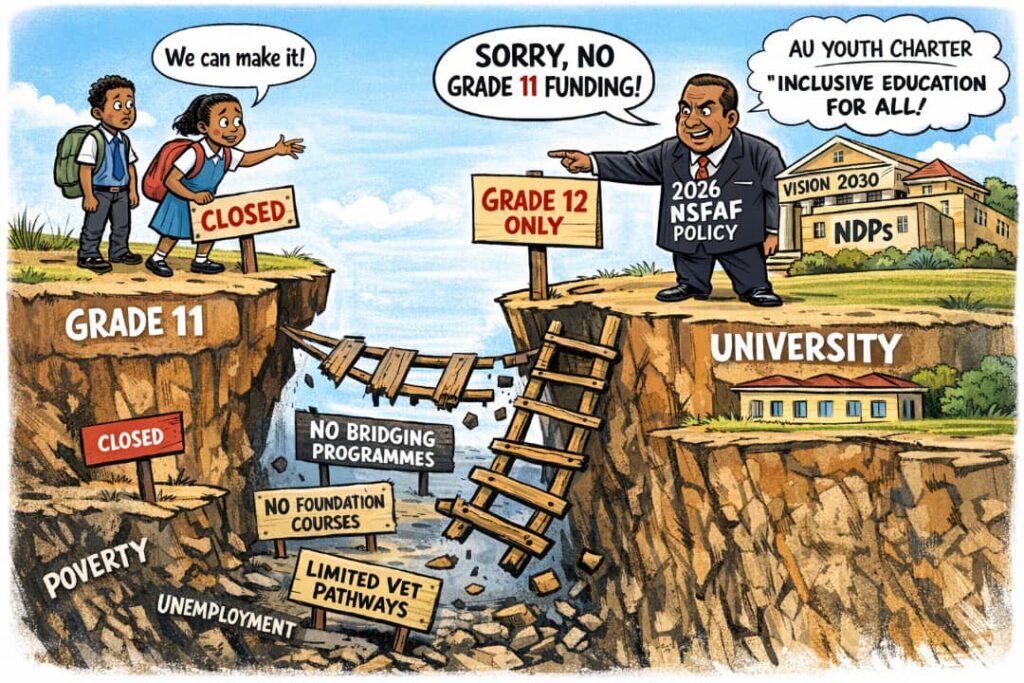
In a statement issued, Shakupakela who is also the President of the National Alliance for Education Graduates Union (NAEGU) and an IYC Ambassador raised concern over the removal of the Grade 11 to tertiary funding pathway. He argued that the policy was introduced without putting in place fully funded and accessible alternative routes for affected learners.

While acknowledging government efforts to improve academic performance, accountability and financial sustainability, Shakupakela said the current policy setup conflicts with Namibia’s long-term development goals, including Vision 2030, the National Development Plans (NDPs) and African Union youth frameworks.
He explained that Vision 2030 places strong emphasis on inclusive education and skills development, particularly for young people from disadvantaged backgrounds. According to him, closing the Grade 11 entry route without funded transitional programmes risks excluding capable learners, limiting access instead of expanding opportunities, and weakening human capital development.

Shakupakela further argued that the policy does not align with the objectives of the National Development Plans, which prioritise youth empowerment, skills development, employability and poverty reduction. He warned that the new funding rules could increase the number of young people who are not in education, employment or training (NEET), deepen regional and socio-economic inequalities, and push vulnerable youth into long-term unemployment.
At continental level, he said the policy contradicts commitments under the African Youth Charter and AU Agenda 2063, which call on member states to remove structural barriers to education, promote second-chance learning systems and ensure youth participation in development. He stressed that a funding framework that excludes learners without remedial support undermines the vision of a people driven Africa led by its youth.
The education advocate also raised equity and social justice concerns, noting that rural learners, students from under-resourced schools and youth from low-income households are likely to be the most affected. He emphasised that many learners fail to reach Grade 12 due to systemic and socio-economic challenges rather than lack of ability, and said education policy must respond to unequal starting points with targeted support.
Shakupakela called on NSFAF, the Ministry of Education, Innovation, Youth, Sports, Arts and Culture, as well as parliamentary committees on education and youth, to urgently review the policy. His proposals include the introduction of fully funded foundation and bridging programmes, conditional or exceptional entry mechanisms for deserving Grade 11 learners, stronger and well-articulated vocational education and training (VET) pathways, and closer alignment of funding reforms with Vision 2030, the NDPs and AU youth commitments.
He concluded that Namibia’s development cannot be achieved by excluding vulnerable youth, but by supporting them through inclusive and structured education pathways, adding that reforms should improve quality without closing doors to opportunity.
About the Author
Aneli Fura is a Senior Editor at The Updated World, where he oversees and contributes to general news coverage across Namibia. His reporting focuses on crime, accidents, local developments, and other important stories affecting communities across the country.
Related Contents