Kavango’s Silent Crisis: When Resource-Rich Regions Fail Their People – Tjihinga Edward



The Kavango East and Kavango West regions are endowed with natural and human resources that many parts of the country can only envy. Yet for thousands of residents, especially young people and learners, daily life reflects deprivation rather than opportunity. This contradiction raises serious questions about leadership, priorities, and accountability at regional level.
Youth unemployment remains one of the most pressing challenges in the Kavango regions. What makes the situation particularly alarming is that many of the unemployed are well-educated young people who have completed secondary and tertiary education but find no meaningful pathways into employment or skills development. Without structured programmes to absorb and develop this human capital, frustration grows and hope diminishes.

The state of the education environment in many communities is equally troubling. Learners are taught in classrooms with poor infrastructure, insufficient furniture, and non-functional sanitation facilities. In some schools, pupils sit on the floor because there are no desks or chairs. Toilets remain unusable due to the absence of water, creating unsafe and undignified learning conditions. These realities undermine both the quality of education and the dignity of learners.
It is important to acknowledge that such learning environments contribute directly to school dropout rates. When children are expected to learn under conditions that strip them of comfort, safety, and self-worth, disengagement becomes inevitable. Society is quick to blame young people for dropping out, yet often ignores the conditions that push them away from the classroom. Education cannot thrive where dignity is absent.

What deepens the concern is that these challenges exist alongside abundant local resources. The Kavango regions have timber, yet schools lack basic furniture. Communities live alongside the Kavango River, yet many households and public institutions struggle to access reliable water. Gravel and sand are readily available, yet roads in many areas remain in poor condition, limiting access to schools, clinics, and economic activity. These contradictions point not to scarcity, but to weak coordination, planning, and leadership.
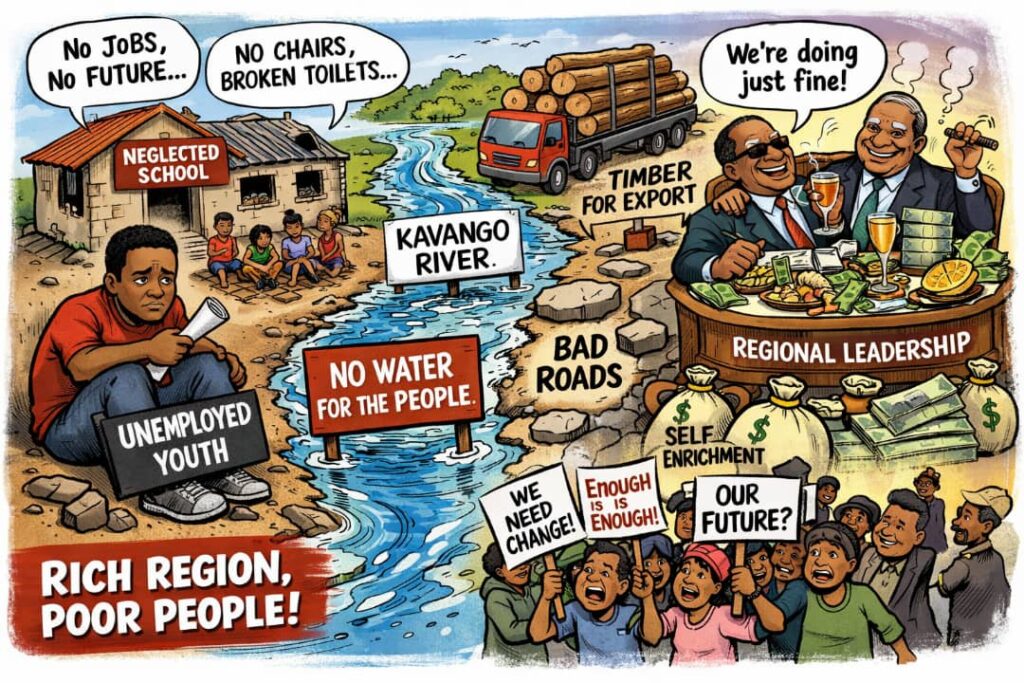
Leadership at regional level must be felt in the daily lives of ordinary people. It must translate natural resources into tangible benefits such as employment, infrastructure, and essential services. When this does not happen, public trust erodes, and communities begin to feel abandoned by those entrusted to serve them.
The future of the Kavango regions depends on deliberate action. Regional authorities, in collaboration with central government, must prioritise school infrastructure, water provision, youth employment initiatives, and transparent management of local resources. Equally important is meaningful engagement with communities and young people, whose voices are often excluded from decision-making processes that directly affect them.
Kavango’s challenges are not insurmountable. What is required is leadership that places people before personal gain, service delivery before self-interest, and long-term development before short-term comfort. The youth and learners of Kavango are not asking for special treatment; they are asking for dignity, opportunity, and a fair chance to contribute to the development of their region and country.
About the Author

The Updated World delivers timely and well-researched articles on various topics, including the latest news updates, health, wellness, sports, current affairs, and more.
Related Contents